

Chapter 1 – Introduction
In January 2023, South Oxfordshire and Vale of White Horse District Councils commissioned LUC to prepare a Landscape Character Assessment covering the two districts (together referred to herein as the ‘study area’).
The Landscape Character Assessment is part of a suite of landscape evidence contributing to the Joint Local Plan that will guide development in the districts to 2041 as shown in the figure below.
Suite of landscape evidence bases
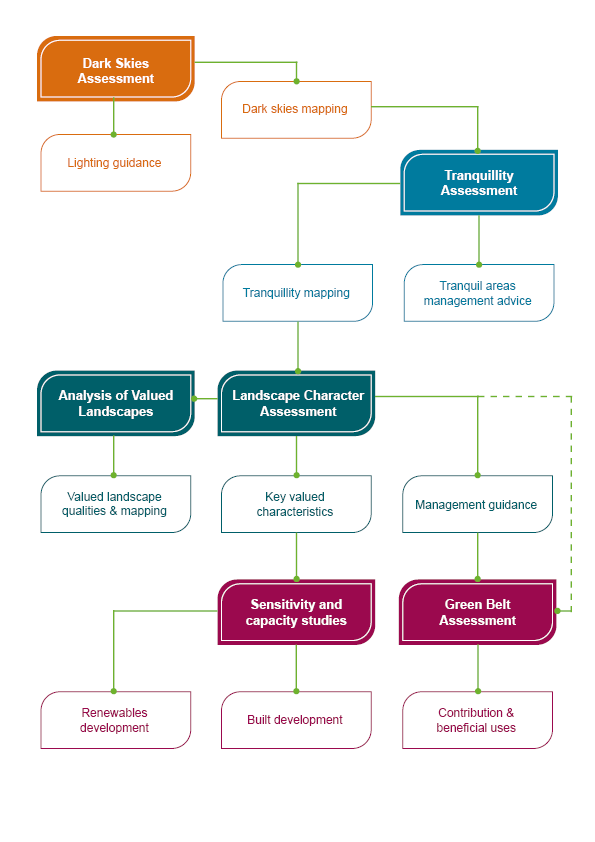
The aim of the Landscape Character Assessment is to create a comprehensive and up to date strategic scale landscape evidence. It provides a robust evidence base to underpin the production of the Joint Plan and to assist in the local planning process. It is intended to both inform work on policy development and development management, guiding development that is sympathetic to local character and the qualities/values of the landscape. It can help inform locational policies for strategic development as well as appropriate design and mitigation, providing a framework for more detailed landscape studies and sensitivity assessments as well as baseline evidence for more detailed Landscape and Visual Impact Assessment (LVIA).
Wider application of the Landscape Character Assessment may include land management, notably implementation of agri-environment schemes, such as the Environmental Land Management Scheme (ELMS), and land use change to achieve net zero, including opportunities for woodland creation.
In summary, the document can be used to consider landscape character when considering any type of change. This includes opportunities for conserving existing character and strengthening and enhancing character, as well as opportunities to create new character.
This study focuses entirely on rural and urban-fringe landscape and does not encompass consideration of the character of larger urban areas, including market towns and local service centres (such as Abingdon-on-Thames, Botley, Didcot and Thame) and larger rural villages (such as Berinsfield, Steventon, Watlington and Wootton). It is understood that a new settlement hierarchy, defining tiers of settlements, is being proposed by the local authorities, but at time of writing this has yet to be adopted.
The Role of Landscape Character Assessment
The process of Landscape Character Assessment is described in ‘An Approach to Landscape Character Assessment’ (Natural England, October 2014). Within this document landscape character is defined as “a distinct, recognisable and consistent pattern of elements in the landscape that makes one landscape different from another, rather than better or worse”.
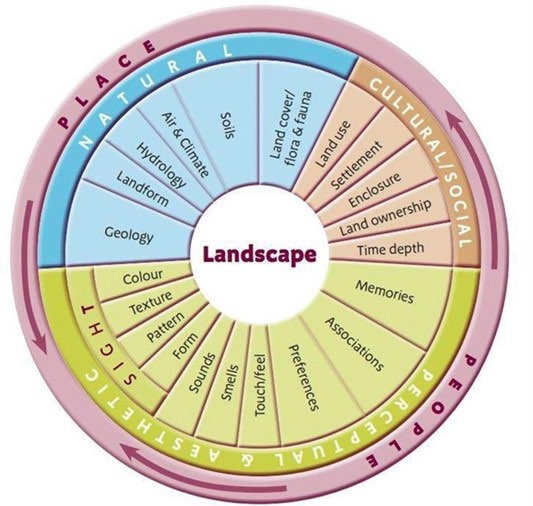
Landscape Character Assessment is the process of identifying and describing such variations in character across a landscape. It seeks to identify and explain the unique combination of features and attributes (characteristics) that make different landscapes distinctive. The landscape is the result of the interaction between people and place which gives an area a local identity. The ‘landscape wheel’ below illustrates how the different natural, cultural, and perceptual attributes of a landscape combine to produce character.
Understanding the character of place and evaluating an area’s defining characteristics is a key component in managing growth sustainably and ensuring that the inherent character and qualities of the landscape can continue to be appreciated. Understanding of character can be used to ensure that any change or development does not undermine whatever is valued or characteristic in a particular landscape and help guide positive change that conserves, enhances, restores, or creates local character.
The European Landscape Convention
The European Landscape Convention (ELC) came into force in the UK in March 2007. It establishes the need to recognise landscape in law; to develop landscape policies dedicated to the protection, management and planning of landscapes; and to establish procedures for the participation of the general public and other stakeholders in the creation and implementation of landscape policies. The ELC definition of ‘landscape’ recognises that all landscapes matter, be they ordinary, degraded, or outstanding: “Landscape means an area, as perceived by people, whose character is the result of the action and interaction of natural and/or human factors”.
The ELC puts emphasis on the whole landscape and all its values and is forward looking in its approach, recognising the dynamic and changing character of landscape. Specific measures promoted by the ELC of direct relevance to this study include:
- The identification and assessment of landscape; and
- Improved consideration of landscape in existing and future sectoral and spatial policy and regulation
This Landscape Character Assessment makes a key contribution to the implementation of the ELC in the study area. It helps to reaffirm the importance of landscape, coordinates existing work and guides future work to protect, manage and plan the landscape.
Using the Assessment
A glossary of terms is included in Appendix A and guidance on how to use the assessment is set out in Appendix C.